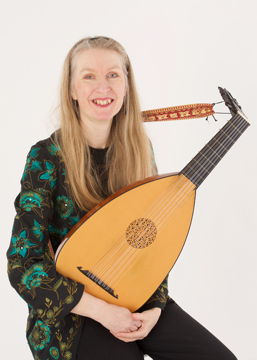
Duo Pietrobono
Duo Pietrobono was formed in 1993 by Catherine Perrin and Jean-Paul Bazin, who are both lute pupils of Francisco Orozco. Catherine Perrin has worked on the mixed finger and plectrum technique which some scholars think makes the link between the monodic plectrum technique of the medieval period and the polyphonic finger technique of the sixteenth century. Jean-Paul Bazin has researched the history of the mandolin, especially the golden era of the eighteenth century, and the history of the gittern, which is an early ancestor of the mandolin. The Duo has performed several times in Paris and won, after only four years of existence, the first prize for chamber music at the mandolin contest in Savona (Italy, December 1997). After a course with Crawford Young during the Ancient Music Week in Gijon (July 2004), they were invited to play a concert in Basel during the gittern and citole seminar of the Scola Cantorum (April 2005).
The duo of gittern and tenorista lute was one of the first fixed forms of instrumental chamber music, probably already during the fourteenth century, and is well documented during the fifteenth century. Geoffrey Chaucer (c.1343-1400) mentions gittern and lute in the Pardoners Tale and one of the greatest mediaeval composers, Guillaume de Machaut (c. 1300-1377), also speaks about gittern and lute in his poems. One of the first known gittern virtuosos is Rodrigo, at the court of Gaston of Foix and he was among the composers collected in the Chantilly Codex of c. 1400, as were Solage, Vaillant and Philippus. Several ars nova composers, among them Machaut and the blind organ player Francesco Landini, were collected in an instrumental codex held in Faenza (Italy), which we used as an example to treat some of the other songs of Italian ars nova by Landini and Ciconia.
One of the best known gittern virtuosi, Pietrobono del Chitarino, was active in Ferrara in the second half of the fifteenth century, playing diminutions of songs and dance music soprano parts, always accompanied by his tenorista (a lute playing the tenor line, the basis of the compositions at that time). Two manuscripts are representative of the music played in Ferrara, the first one, copied about 1465, is now in Porto and contains pieces by Dufay and several English composers. The second one is the Castanense Manuscript, compiled about 1490 for Isabella d'Este's wedding, and was probably supervised by Johannes Martini, the main Ferrara court composer with whom it is thought Pietrobono often worked. Loyset Compre was also active in this Ferrara circle, and his two pieces are preserved in another great instrumental music codex, now in Segovia Cathedral, Spain, (copied around 1502), near works by Ockeghem and Martini.
In Germany around 1450, a blind lutenist and organist, Conrad Paumann (c. 1410-1473), is said to have invented the tablature system which allowed players and composers to notate polyphonic music more easily for fretted instruments like the lute and gittern. This must have deeply impressed Italian musicians when he visited their country shortly before his death. The Buxheim Organ Book was written in the circle around Paumann and contains among others instrumental versions of Dufay's songs. It is a great collection of pieces with a florid soprano line accompanied by slow-moving tenor and contratenor lines which is perfectly suited for our type of ensemble, This tradition of lute and gittern duo disappeared at the beginning of the sixteenth century, the last evidences of this practice are the Venetian tablature editions of Spinacino (1507) and Dalza (1508). It is interesting to note that Isabella d'Este was fond of the lute (probably influenced by hearing Pietrobono in her early years) and was taught by Testagrossa, who also taught Francesco da Milano, the great renaissance lute virtuoso. The change from plectrum to finger playing of the lute happened somewhere between Ferrara and Germany, around Paumann and Testagrossa... Our concert explores this territory.
|