An Illustrated History of the Lute
Part One
The European lute derives both in name and form from the Arab instrument known as al ‘Ud, which means literally ‘the wood’ (either because it had a soundboard of wood as distinct from a parchment skin stretched over the body, or because the body itself was built up from wooden strips rather than made from a hollow gourd). The Arab ‘Ud was introduced into Europe by the Moors during their conquest and occupation of Spain (711-1492). Pictorial evidence shows Moorish ‘Ud players, and 9th and 10th century accounts tell of visits of famous players such as Ziryab to the court of the Andalusian emir ‘Abd al Rahman II (822-52). This ivory box dates from 968 the reign of al-Mugira the son of Abd al Rahman III in Andalusia and shows one of the earliest representations of an ‘Ud. It is being played standing up and in the detail you can see that the player is using a substantial plectrum. The figures are also wearing their hair in a style apparently also introduced by Zyriab, who seems to have been something of an arbiter of taste in Andalusia. He even founded a music school in Cordoba.
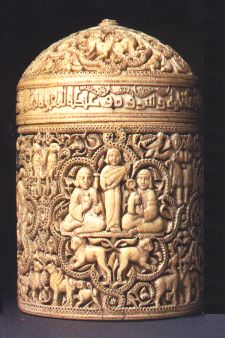
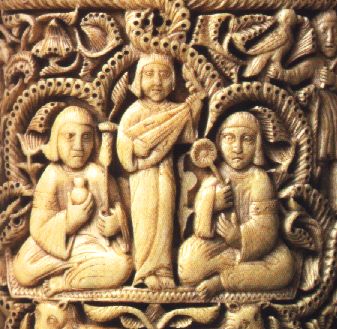
Ivory box (15cm high) in Louvre Museum, Paris.
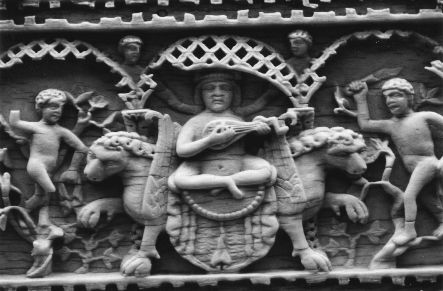
Byzantine ivory carving (9th - 10th century) part of four panels.
Hessisches Landesmuseum, Darmstadt No. Kg. SU. 215
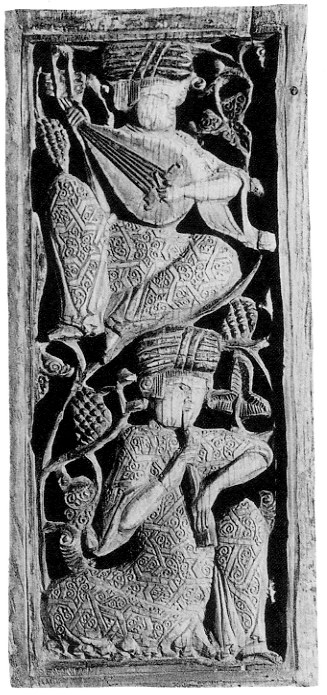
Detail of an ivory box (Spain 12th century)
National Museum, Venice
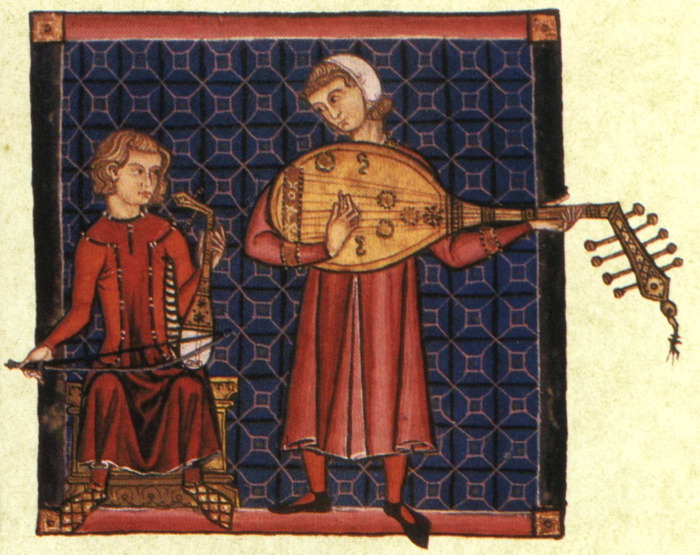
The ‘Ud was not confined to Muslims, however, as is shown by illustrations to the Cantigas de Santa Maria of Alfonso el Sabio (1221-84) which include players in distinctive Christian costume.
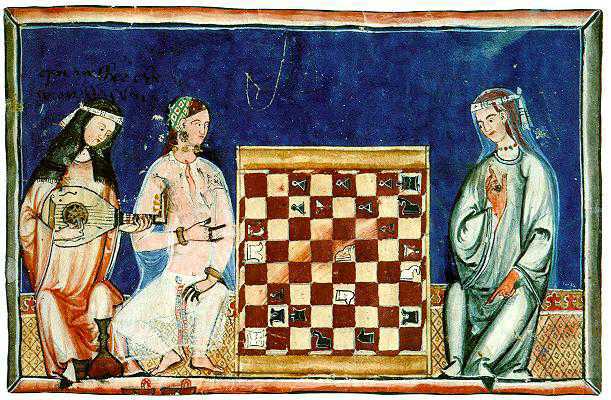
Also a book of chess endgame problems also commissioned by Alfonso X “el Sabio” in 1283 shows a lute with a more western-looking pegbox. The chess game is being played between a woman in arab costume on the left with henna decorated fingers and a woman in Christian costume on the right. The luteplayer appears to be wearing Christian costume.
Just after the chess book there is an interesting diagrammatic drawing of a five course fretted ’ud from the book “Kitab al-adwar” by Safi al Din 'Abd al-Mu'min b. Fakr al-Urmawi of 1333-4.
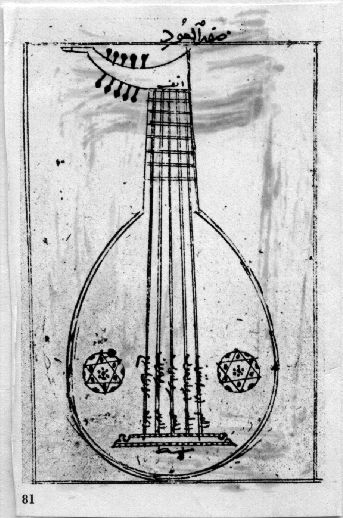
It is an important arab treatise on musical theory (he also wrote onother
one) and was written while Safi ad-Din was working in the library of the
Caliph al-Mustassim. The oldest known copy ot the kitab al-adwar was finished in 633/1236 (Ms
Nuruosmaniye 3653) when the author was only 20 years old.! (did he actually write
it?) Chronologically it is the first scientific treatise on music after that
of Ibn Sina. The kitab al-adwar contains a lot of information on the 5 course 'ud which, at that time, was still a new and little practiced lute. It also provides the proportions between length and width of the various parts of the 'ud.
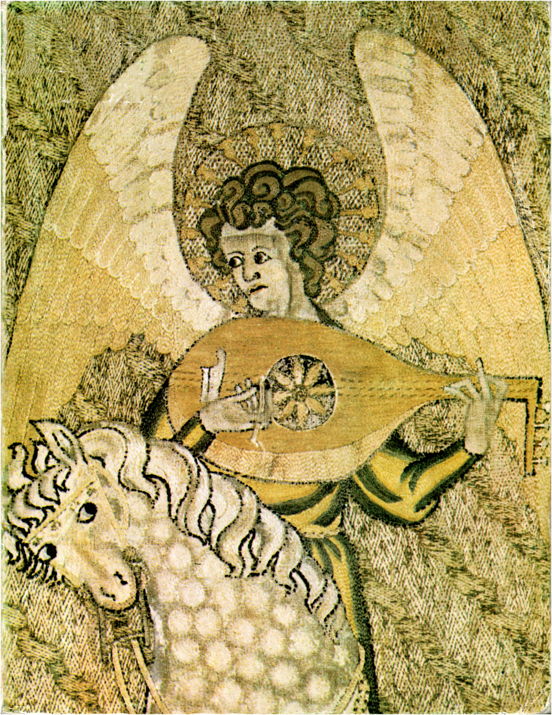
However from pictorial and written evidence it is clear that by 1350 what we must now call lutes, since there is no longer a connection with Arab musicians, had spread very widely throughout Europe, even though trading and cultural links with Moorish Spain were not well developed. For instance this wonderful embroidery of a lute-playing angel on the English Steeple Aston cope, one of the first depictions of a lute in England, circa 1320. Expensive garments such as the Steeple Aston cope were symbols of wealth, power and high status, so if the lute could be recognised well enough to justify such prominence it must have been present in England for quite some time, which pushes back its arrival in these islands to more or less the same sort of time as the Cantigas illustrations c.1250. We are a long way from any direct contact with the Moors so it is a puzzle to understand the extremely rapid spread of this instrument right across Europe. But Peter Holman’s Four and Twenty Fiddlers (Oxford 1993) on the parallel introduction of the violin suggests that such developments were strongly top down, with innovations happening in royal courts and then spreading downwards through society. So we should probably look to royal and courtly retinues. In 1254 Alfonso el Sabio, the very same king who commisioned the Cantigas illustrations, signed a treaty of alliance with Henry III, King of England and Duke of Aquitaine, supporting him in the war against Louis IX of France and in the same year Alfonso’s half sister, Eleanor of Castile, married Henry’s heir to the throne, Edward I. The link is suggestive that perhaps the lute was present in court circles from this time onwards and was added to the cope as a further symbol of the courtly life.
Although we need to look elsewhere for a route that would lead to the eventual domination of European lute making by numerous German families who came originally from around the Lech valley region and Bavaria. Bletschacher (1978) has argued for a similar top down influence: that this was due largely to the royal visits of Friedrich II with his magnificent Moorish Sicilian retinue to the towns in this valley between 1218 and 1237. The valley was a main north-south trading route across the Alps and the necessary raw materials grow there in abundance so it would have been a natural focus for any such development to occur. Especially following the capture of Constantinople in 1204 by the Venetians helping the second Crusade which so greatly increased their trading activities with the Near East.
The ‘Ud is still in use although it no longer has frets and over the centuries has undergone structural changes analogous to those of the lute, which mean that it is not the same now as either the original ‘Ud or the medieval lute.
As no lutes from before the 16th century have survived, information must be gathered from pictures, sculpture and written descriptions. These indicate that the lute has usually had its strings in pairs, and that at first there were only four such 'courses' and that they were usually played with a plectrum.

Coronation of the Virgin (detail), c.1360, Torone da Verona, Museo di Castelvecchio, Verona, Italy

Virgin of the Angels (detail) c.1385 Museu Nacional d'Art de Catalunya, Barcelona
https://www.lutesociety.org/lute-idb/showItem.htm#LI-201
Click here to see a reconstruction of this type of lute.
From the start, lutes were made in widely different sizes, and therefore of different pitches, here is a particularly large one.
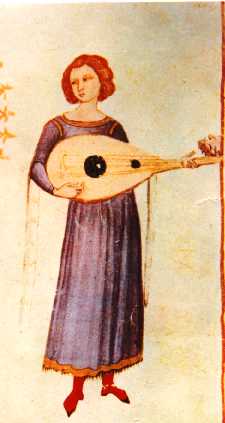
Manlius Severinus Boethius, De Musica, Naples, Biblioteca Nazionale, Ms. VA 14, fol. 47 recto. Alternately described as Allegory of music, manuscript V A folio 27 from The Music Institute by Severin Boezio
Full image at:
https://www.facebook.com/photo/?fbid=1002211945895434&set=a.845090341607596
Both pictorial and written evidence points to the use of different sized lutes for treble and ground duet performance. (see Polk, 1992)
During the 15th century a fifth course was added. In 1426 Masaccio shows two five course lutes in his altarpiece,
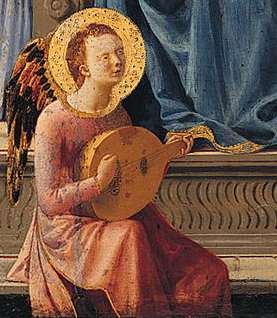
(Virgin and Child, National Gallery, London).
And at the same date, 1426, Luca della Robbia carved this 5 course lute on the Cantoria in Florence.
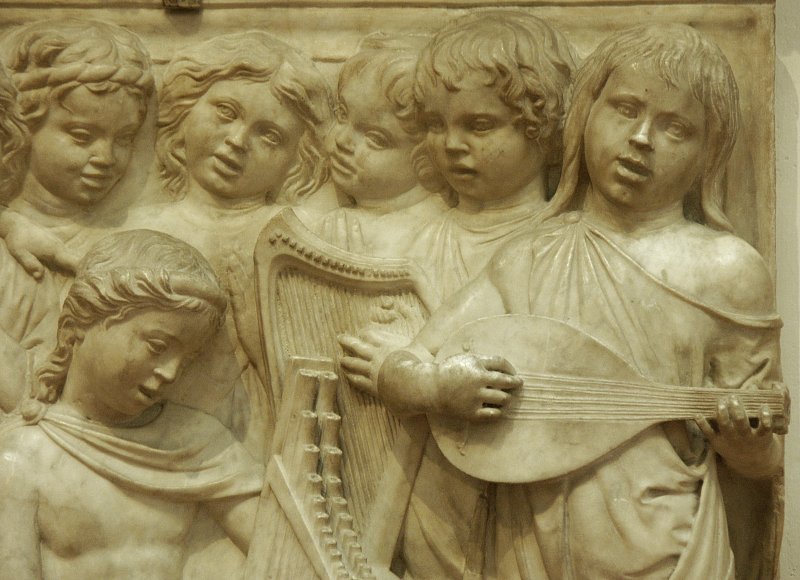
Click here to see a reconstruction of this type of lute.
Later, c.1481-3, Tinctoris mentions a sixth course and there are even tablatures from this period calling for a seven course lute, and indeed a there is a circa 1490 triptych from the cathedral in Burgos, Spain clearly showing a seven course lute with octaves on the sixth and seventh courses.

Detail from a triptych by Goswijn van der Weyden now in Burgos Cathedral, Spain.
And a tempera panel painting from c. 1470 clearly showing a lute with seven single courses which is probably a schematic representation of the normal double courses.

Meeting of Jephthah and his Daughter, c.1470 attributed to Benvenuto di Giovanni (1436-1518), Private collection
https://www.lutesociety.org/lute-idb/showItem.htm#LI-2353
However it could instead be a four course lute with three double courses and a single chanterelle. Here is a closeup for you to decide.

The earliest extant account of structural details for the European lute is in a manuscript of about 1440 written by Henri Arnaut de Zwolle.(see Harwood, 1960).
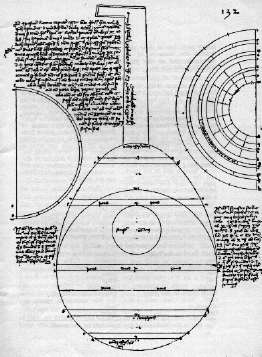
You can read my longer essay on this design here
Arnaut described both the lute itself and the mould on which it was built, combining the two in the same diagram. His design was unmeasured but instead was worked out in terms of geometrical proportion, including the positions of bridge, soundhole and three transverse bars. Almost 200 years later, Mersenne (1636) described the design and construction of a lute by remarkably similar methods. By his time the number of soundboard bars had doubled, but the placing of three of them, as well as that of the soundhole and bridge, corresponds with that given by Amaut. There can be no doubt that there was a well-established tradition of instrument design by geometrical methods, going back to the ‘Ud at least as far as the 9th and l0th centuries (see Bouterse, 1979). It is perhaps significant that when the lute maker Gaspar Duiffoprugcar (1514-1571) commissioned from Pierre Woeiriot a portrait of himself in 1562, surrounded by his lutes and other instruments, he is shown holding, not any woodworking tool but a pair of dividers in his right hand, implying that the geometry was the most important part of the matter of lutemaking.
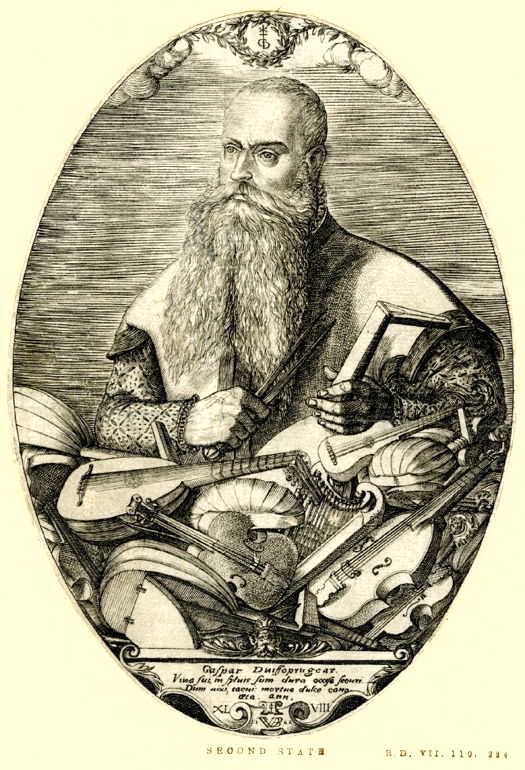
AN606134001
© The Trustees of the British Museum
However when Arnaut’s design is compared to lutes shown in most paintings of the period it is in fact rather different, being oddly rounded at the top of the body. The very long neck he specifies is almost never shown. Suggesting that, as an enquiring scholar, he may have been given the general principles of design by the lute-maker(s) he consulted, but not the exact relationships which determine the precise shape and which may have been regarded as a craft secret. I discuss a possible solution to this discrepancy in a detailed article here
Medieval lutes usually had two circular roses, one large and more or less halfway between the bridge and the neck, as specified by Arnaut, the other much smaller and higher up the body close to the fingerboard. The large rose was occasionally of the ornate ‘sunken’ variety, often with designs similar to some gothic cathedral windows. This may have been intentional for Arnaut calls the rose in his drawing ‘Fenestrum’. For instance the famous painting of the Nativity (c. 1470) by Piero della Francesca in the London National Gallery show two lutes with this kind of rose. Although the painting has been cleaned to within an inch of obliteration these roses can just be made out.
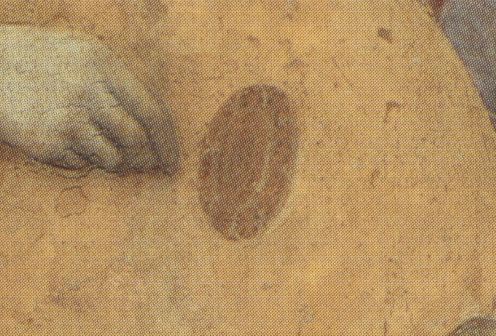
Around 1480 there was even a brief fashion for the upper rose to be in the form of a lancet window.

Gerard David (1460-1523) Virgin and Child with Four Angels (detail) c. 1510
Metropolitan Museum of Art, New York, USA
Interestingly just such a rose has survived in the clavicytherium now in the Royal College of Music, London, which has been dated to about 1480.(see Wells, 1978)
Click here to see a reconstruction of this type of lute.
The ‘Ud was, and still is, played with a plectrum, and at first the same method was used for the lute. With this technique it was probably mainly a melodic instrument, playing basically a single line of music, albeit highly ornate, with perhaps strummed chords at cadences and other important points. However some of the very early plectra are shown as large and solid looking, so it may also have been used as a percussive rhythm instrument rather like the Rumanian Cobsa, which closely resembles the very early medieval lute, especially in the wide spacing of the strings at the bridge and the shortness of the steeply tapering neck. (see, Lloyd, 1960) This may explain the early drone tunings (see § The tunings of the lute).
During the second half of the l5th century, there was a change to playing with the fingertips, and the change can be beautifully seen in these two images which are otherwise so similar that maybe Perugino had seen the Botticini.
The first is circa 1460 by Francesco Botticini and shows a fine quill plectrum held between the first two fingers while the lute itself seems to be a 5 course lute of the medieval type with a flowing curve between the neck and the body.
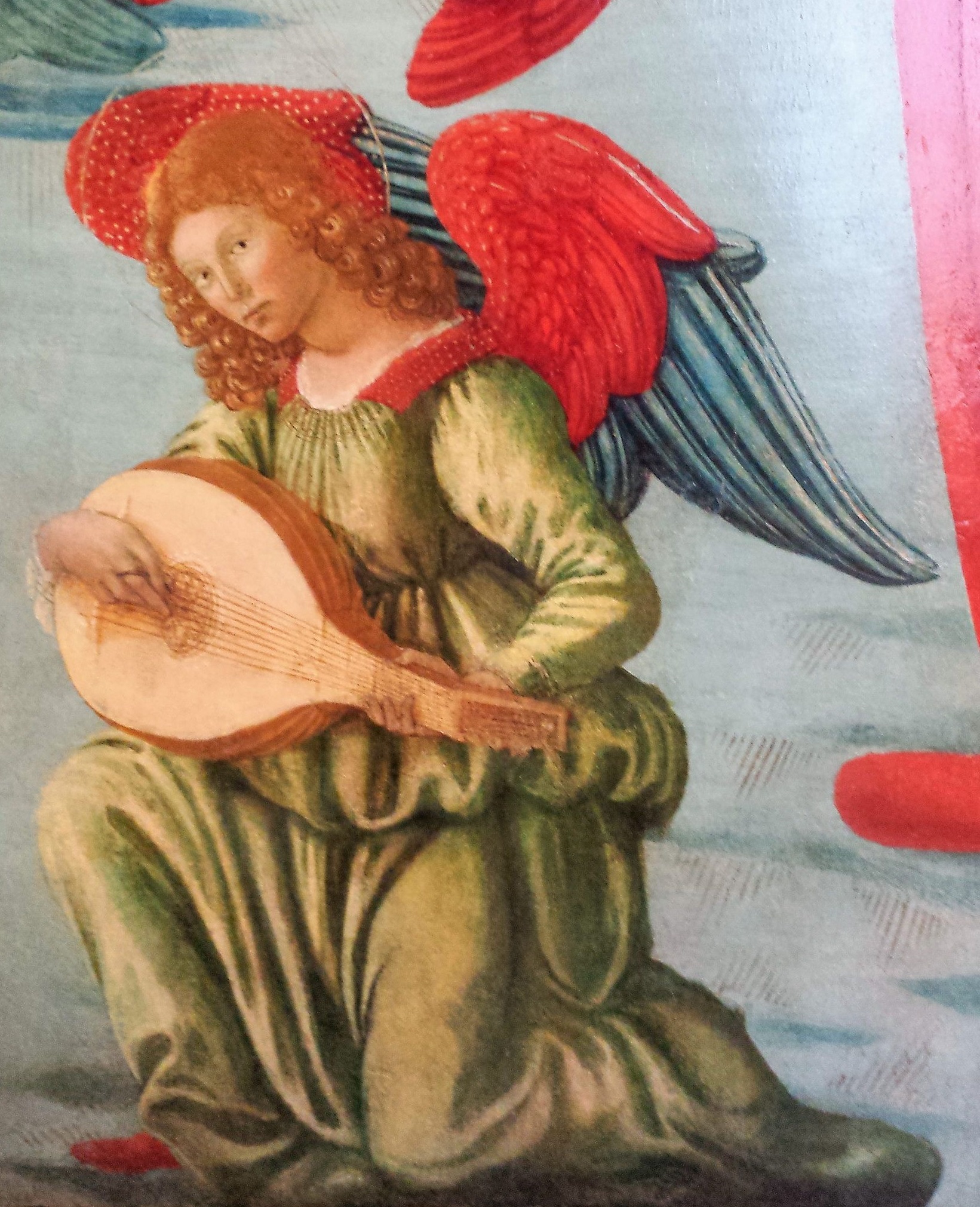
Francesco Botticini (1446-1497) Coronation of the Virgin (detail)
Galleria Sabauda, Turin, Italy
While this drawing from about 50 years later shows the more modern type of lute with a clear angled joint between neck and body and that Perugino was particularly interested in the different right hand position involved in plucking separate strings with fingers and thumb. Both appear to be five course instruments and in both cases the player holds the lute more or less horizontal and has the left hand thumb high over the back of the neck, a feature common to early five course lute playing.
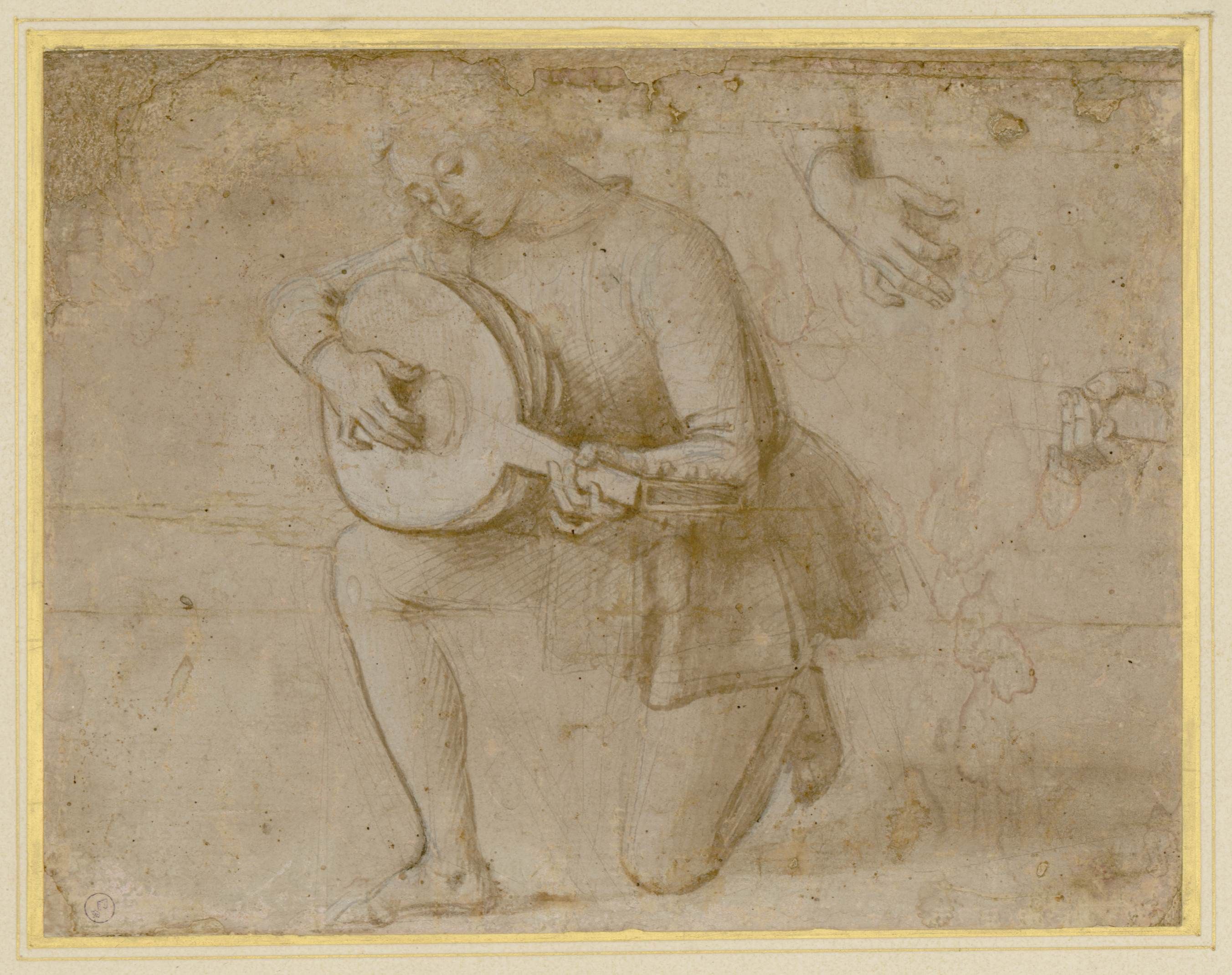
Pietro di Cristoforo Vannucci, detto Perugino, Study of a youth playing the lute
Biblioteca Reale di Torino, Turin, Italy
As Page (1981) pointed out, the two methods continued for some time side by side. Tinctoris (c.1481-3) wrote of holding the lute 'while the strings are struck by the right hand either with the fingers or with a plectrum', but did not imply that the use of the fingers was a novelty. However, the change was very significant for the lute's future development, for it allowed the playing of several parts at once, and meant that the huge repertoire of vocal part music both sacred and secular became available to lute players. This function was made easier by the invention about this time of special systems of notation known as tablature into which much of this repertoire was transcribed [intabulated]. There were three main kinds of tablature for the lute, developed in Germany, France and Italy respectively. A fourth early system, 'intavolatura alla Napolitana', was also used from time to time. Of the four main types the French may have been the earliest. The German one was probably written during the lifetime of Conrad Paumann (d 1473), the supposed inventor of the system. Although Tinctoris had mentioned a six-course lute, these first tablatures, and indeed the very names by which the strings of the instrument were known, suggest five courses as still the most usual number at this time.
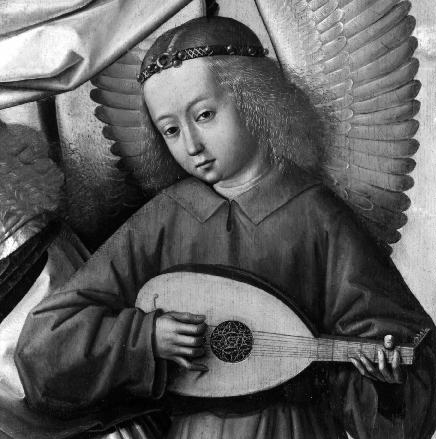
Click here to see a reconstruction of this type of lute.
By about 1500 a sixth course was commonly in use, which extended the range of the open strings by another 4th to two octaves.
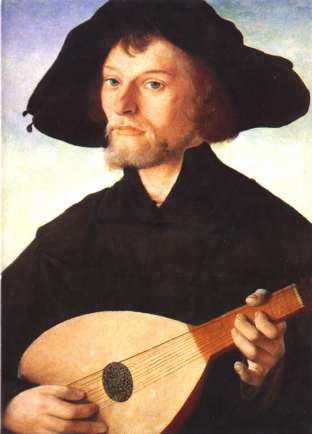
Click here to read more details about this painting.
This may have been enabled by improvements in string-making. Gut was used for all the strings and it was usual on the two or three lowest courses to set one of the pair with a thin string tuned an octave higher, to lend some brilliance to the tone of its thick neighbour.