|
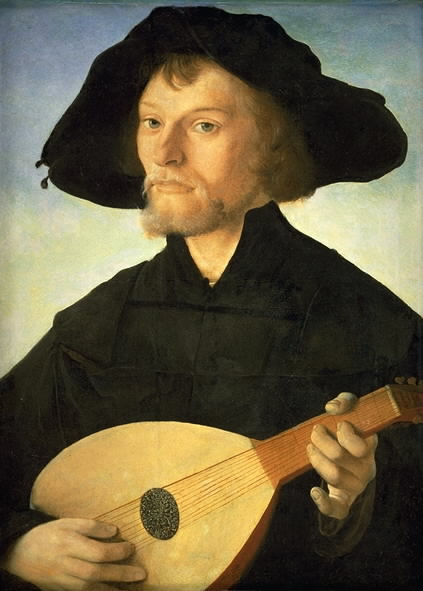
This fine portrait in the tradition of Dürer and Holbein is attributed to Jan van Scorel. He was trained in Amsterdam and travelled more widely than many a modern painter! He was in Utrecht by 1517 and in 1519 he set off on a journey to Germany and went to Nürnberg to visit Dürer. By 1520 he was in Carinthia, where he painted a triptych still in Obervellach Parish Church. He went on to Venice, where he met and was influenced by Giorgione, and then on to Jerusalem on a pilgrimage. He returned to Venice in 1521 and then to Rome where he was fortunate enough to coincide with the Pontificate of Hadrian VI, the Utrecht Pope. He was appointed inspector of the Belvedere, painted the Pope, was made a catholic Canon of Utrecht, and was deeply influenced by Michaelangelo and Raphael. After Hadrian died Scorel went back to Utrecht (1524), and then Haarlem. In 1540 he travelled to France but by 1550 was back in the Flanders, where he restored the Ghent Altar.
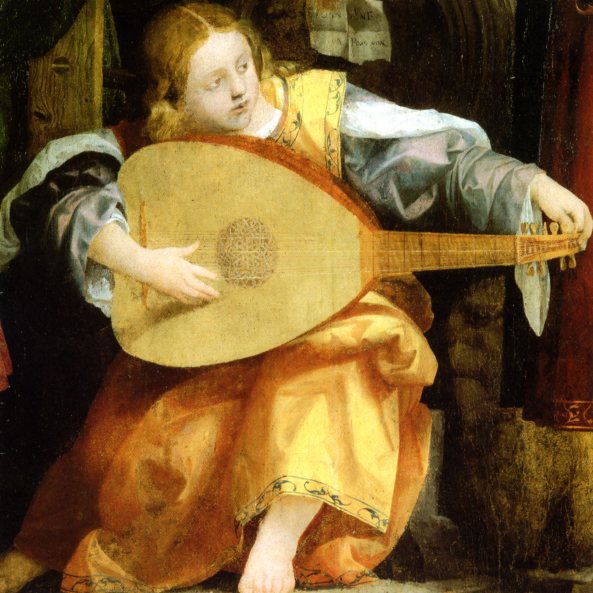
The unknown sitter is playing a little 6 course lute. Perhaps, by its appearance, an A lute of about 53cm string length (though these sizes are notoriously difficult to make more precise than a general impression). Several people have tried to give a spurious air of precision by measuring the distance between the eye pupils of the sitters and using this measurement to scale the instruments. But in fact this distance between the pupils can have a variability of between 50 and 70 mm in adults, so it is precisely useless as a scaling for a lute. We are usually interested in where in the range of 50-70cms the lute size lies and it doesn't take an Einstein to see that the one measurement could simply be a measure of the variability of the other.
However there are several other interesting features of the lute besides its apparent small size. The rose is darker than one would expect of a rose simply carved out of the soundboard. It may well be silver-gilt, as are one or two surviving lute roses, notably the outer chip-carved border on the Basilio Smit lute in Füssen Stadtmuseum. The pattern is not discernable at this resolution, but on the museum postcard from which I took it, it is fairly clearly the so-called Leonardo knot design which was much used by the Dieffoprucher family of makers.
The fingerboard joint with the soundboard appears to lie quite a distance beyond the line of the neck/body joint. In fact it comes more or less where the inner edge of the neck block would be, which would mean that the lute was structurally weak, just at this point where it needs great strength to resist the pull of the strings. However the fingerboard is the same colour as the varnish of the back of the lute (not very evident on this scan) and I suspect that what we see is simply varnish, used to protect the fingered surfaces of the front of the neck and the upper part of the soundboard. For, as is made very clear by Le Roy in the seventh rule of his 1567 instructions as reissued by William Barley in 1596, it was common for good players to play beyond the tied neck frets:
The Seaventh Rule
And concerning the letters that come after the i. which is in the last stop of the eight, those letters have no freets at all, notwithstanding those that are expert in this instrument, stop the stringes so certainelye as though they had freets assigned them, and the letters that sometime come after the i. are these k. l. m. and n. but have no freets allowed them.
Now we have spoken of the stringes, letters, freets and stops, it is meete that it bee shewed with which fingers the strings of the Lute must be stopped.
This practice of varnishing the soundboard for a short distance beyond the neck joint actually seems to have been rather a common feature of lutes about 1550, though not one I have ever seen copied on a modern lute. For comparism look at this 1526 portrait by Hans Maler of Mathäus Schwartz (1487-1574) who was an associate of the Fugger banking family.
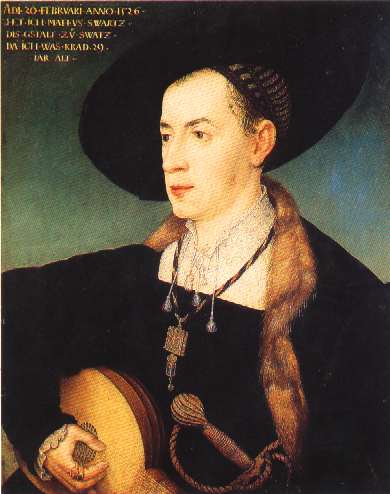
Hans Maler 1526, Mathäus Schwartz (1487 - 1574)
Louvre Museum, Paris
Here the fingerboard or varnish edge comes about the same distance down over the neck joint line as on the Scorel lute but the colour is more clearly the same as that of the back of the lute. (Look, too at the rose for comparison - this one is clearly NOT silver-gilt.)
For confirmation, also look at this slightly earlier painting of 1507 by Marco Marziale; the quality of the painting seems to show more clearly that what we have here is a protective coat of varnish over the soundboard rather than the separate fingerboard of contrasting colour we might have expected.
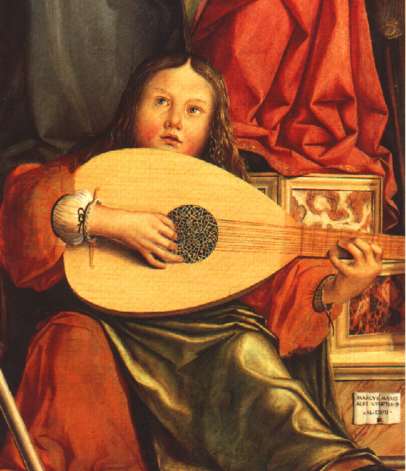
Marco Marziale (active c.1492-c.1507) Detail from Virgin and Child with Saints 1507 Cremona altarpiece.
National Gallery, London
In fact if we look at this even more closely, we can see that the fingerboard is indeed some kind of figured light wood, probably boxwood, while the varnish over the soundboard is a good but not perfect match to it. In fact this is almost an identical effect to that shown on the lute in the Podenone painting I show below
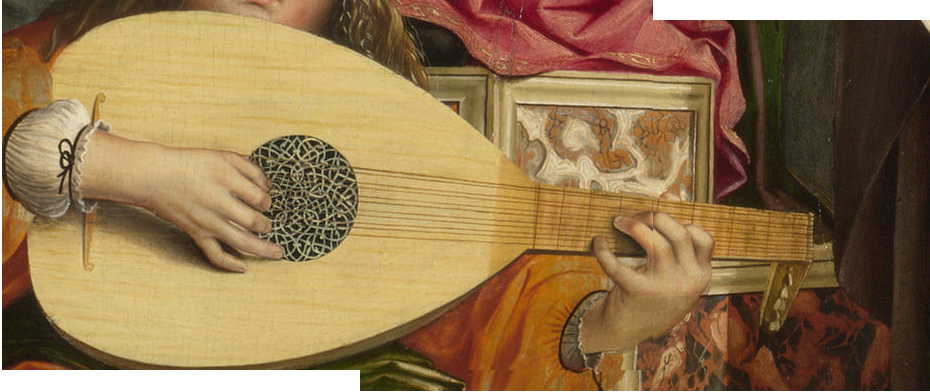
Marco Marziale (active c.1492-c.1507) Detail from Virgin and Child with Saints 1507 Cremona altarpiece.
National Gallery, London
Which leads us back to the question: was a separate fingerboard all that common anyway? We have very few early lutes with original necks, and those we do have tend to be expensive, top-of-the-range instruments, which have survived disproportionately because of their obvious collectable value. The 7 course lute by Giovanni Hieber of c1580, which seems to be of a more ordinary standard, simply has the top surface of the solid sycamore neck painted black, and this, or varnish, may have been much more common for the period than is now apparent. Especially when you remember how rare and expensive ebony and rosewood must then have been. The need for varnish to protect the upper part of the soundboard increased as the 16th century progressed and music reaching further up the scale became more common. Especially this would be the case before the invention of the little wooden soundboard frets which Dowland, in the introduction to his son's Varietie of Lute Lessons of 1610, attributed to the English player Mathias Mason .
"But yet as Plautus saith, Nature thirsting after knowledge, is alwayes desirous to invent and seeke more, by the wittie conceit (which I have seen, and not altogether to be disalowed) of our most famous countriman M. Mathias Mason Lutenist, and one of the Groomes of his Maiesties most honourable Privie Chamber, (as it hath ben told me,) invented three frets more, the which were made of wood, and glued upon the belly......... "
These little frets serve somewhat to protect the soundboard from the worst of the finger grease and before their introduction a coat of varnish must have seemed more necessary.
One of the clearest pictures I know of, showing varnish going to a distance into the soundboard which makes it impossible structurally to have been a fingerboard, is the 16th century copy (now in Utrecht) of a lost Breughel . It is also more than a little 'down-market'.

Detail from Vastenavonddans
Rijksmuseum, Het Catherijneconvent, Utrecht.
Also this gradual colour change would be impossible if it were due to a change of the wood used. but there does seem to be a deepening of the colour on the neck itself, suggesting that there could also be a fingerboard, with or without varnish.
Recently (2006) Mike Lowe has called my attention to a painting by Pordenone which shows this effect even more clearly. Here there is a figured fingerboard AND coloured varnish to match the back.
Giovanni Antonio Pordenone (1483/4 -1539)
Madonna and Child Enthroned with Saints. c. 1525
Parish church, Susegana (Treviso). (Reference courtesy of Gernot Hilger)
An interesting corollorary of this clearly evident varnish on the upper part of the soundboard is the lack of evidence for any varnish on the main body of the soundboard. It is hard to detect any finish at all on surviving lute soundboards. Following Peter Forrester's work on making historic oil varnishes (The Strad, April 1988 pp. 304-7) it is apparent that it is much harder to make a modern style clear varnish than a coloured one. Thus it may well be that normally the soundboard was not protected at all. Modern lutes without varnished soundboards often show the most disgusting amount of dirt, but this is largely due to to the use of modern copper-wound strings in the bass which corrode slightly with perspiration (some players' more than other's!) and leave greenish verdigris stains on unprotected wood. Gut by contrast, does not shed contamination to nearly the same extent, and so the need for protection may be a rather inadvertant consequence of inauthenticity!
Which brings me to the strings of our little Jan van Scorel lute. It is very clear that courses 2-5 are strung in unison, with gut of increasing thicknesses, while the sixth course has a very thick fundamental string with a much thinner octave. The thick string does look as if it might be high twist, but there is no evidence of the colouring which might indicate 'loading' of this bass string. The Marziale bass string looks identical.
|